
PPPPrinciples for Perpetual Chaos - Four Ps #273
Four Laws for Social Clarity: Equilibrium, Entropy & a Golden Rule

Here’s the thing about rules. We pretend we hate them, but we secretly crave them and cling to them like WiFi on a long flight.
Humanity has always needed a framework to make sense of the chaos. Ten Commandments. Four Noble Truths. Newton’s Three Laws. The Three Laws of Thermodynamics. Hammurabi’s Code. The Five Pillars. The 42 Laws of Ma’at. Even Martin Luther’s 95 Theses, if you want to go deep.
We invent rules to explain the world… then rewrite them when the world stops behaving.
So for this edition of The Four Ps, we’re drafting our own: The Four Rules of Social Clarity. A new operating guide for a society that keeps buffering.
From Personal to Practical, from Professional to Political, we pull from the sciences, the sages, the philosophers, and the fabulously unhinged.
Consider this your sneak peek at the new rulebook.
And yes, we’ll probably break half of it by next month.
Personal: The Law of Equilibrium... Why You To Push Beyond the Status Quo
Most things in life drift back toward the mean. That is the law of equilibrium in its simplest form.
Nature wants balance. Systems settle. People settle. Companies settle.
And honestly, equilibrium is great if you’re a beaker of iodine.
Not so great if you are a human trying to do anything interesting.
Chemical equilibrium describes the point where reactions stop changing. Physical equilibrium describes forces balancing each other out. Professional or personal equilibriums are the curse of “the safe option.”
You know I’ve never played it safe. That whole saying about forgiveness over permission... yeah, that was probably created for me. Because these days, the status quo is not safe.
The status quo is the risk.
We need to stop treating bold creative ideas and innovative technologies as “risky” or “shiny objects.”
Playing it safe is how brands become invisible. The data is right there. Attention is harder to earn. Ad recall is declining. Competitors are getting louder, stranger, and more willing to redraw the line entirely.
I recently revisited an old campaign I worked on in 2010. It pushed the limits of censorship, brand safety, appropriateness, and our own comfort zones. It was outrageous. It was uncomfortable. And it shifted the line of what was acceptable.
That’s the thing about equilibrium. It is NOT fixed. It moves when you push it.
Status quo is not a law. It’s a habit. And habits can be broken.
Look at what is happening across the marketing industry right now. Celebrity culture, creator culture, and agency culture are merging into a “frienemy” ecosystem. Big agencies and even independents are under threat because creators and talent now operate like studios and agencies themselves. The line is shifting again. And that’s a great thing.
Same dynamic applies to media. And look at what my friends at iHeartMedia are doing.
If any company could have clung to a legacy definition of what they were, it was them. Radio giant. Household brand. A comfortable equilibrium.
Instead they smashed it: All in with podcasts. All in with creator formats. Now all in with audio and video convergence. Just look at the streak they’re on in the past month:
Netflix working on licensed video podcasts from the iHeart network.
TikTok partnering with iHeart on a full blown Podcast Network and co branded studios.
NBCUniversal naming iHeart its exclusive audio partner for the 2026 Winter Olympics.
Amazon DSP expanding its programmatic offering through iHeart.
That’s not equilibrium. That is propulsion.
And now this part gets personal. Because nearly 18 months ago, I met an iHeart executive on a sprinter van in Cannes headed up to a villa party. A chance encounter. A random seat assignment. A moment of disequilibrium.
Fast forward to today. We’re live. Genuin’s video experience infrastructure is embedded across iHeart properties. The engine behind all of the video and engaging experiences mentioned above.
iHeart Highlights powered by Genuin, with all clips from morning shows, podcasts, and talent ecosystems. Ryan Seacrest and Elvis Duran reading the name Genuin on the air.
Equilibrium is not a point you return to. It’s a line you move.
The lesson is simple: If the status quo feels stable, you are probably standing still.
Practical: The Law of Entropy... and Why Everything is Trying to Fall Apart
Entropy is the universe’s way of reminding us that tidiness is a temporary illusion.
The Second Law of Thermodynamics says systems naturally drift toward disorder.
Heat spreads. Structures crumble. The universe trends toward chaos even when we swear we cleaned the kitchen five minutes ago.
Historically this applied to closed physical systems. But today it applies to inboxes, institutions, traffic dashboards, public trust, firewalls, and pretty much every group project in history.
Take my once-beloved and revered alma mater, the University of Pennsylvania.
A university with robust information security still fell to a social engineering hack that blasted offensive emails from University accounts earlier this month.
Their team “shut it down quickly,” but not before the attacker slipped in, grabbed data, and embarrassed the institution publicly with an email for the ages to all alumni.
Penn is “still investigating the nature of the information obtained” because entropy loves a cliffhanger.
Then there is the CBO (or Congressional Budget Office for long). A breach, a still-unknown cause, and speculation about an outdated Cisco firewall.
Systems contained, investigation ongoing, trust slightly bruised. Another institution nudged toward disorder.
Media is wobbling too. AI is tanking traffic to news publishers, sending audience numbers into freefall. Yet somehow advertisers may still save the day.
Collapsing inputs, potentially rising outputs.
Peak entropy.
And the workforce is now in a full blown identity crisis. Sam Altman predicts AI will run entire companies. Dario Amodei says half of entry level white collar jobs vanish.
Yet experts in the LEAP survey predict slight job growth.
Same tech, wildly different expectations.
Entropy thrives on disagreement.
Meanwhile, cyber threats are mutating faster than we can brief them.
Google’s Threat Intelligence Group reports malware now alters behavior mid execution, uses AI to generate malicious scripts on demand, and hides its own code to evade detection.
State sponsored actors from North Korea, Iran, and China are leveling up with AI tools. Underground markets are flooded with deepfake generators, phishing kits, and vulnerability scanners. The barrier to entry for chaos keeps dropping.
Here’s the practical truth: Entropy is undefeated.
Systems drift toward disorder unless we constantly push back. The inbox. The institutions. The internet. The infrastructure. All of it slides unless we actively hold it together.
Entropy is not personal. It is physics. But it’s a helpful reminder: If you want stability, you have to generate it because the universe will never do it for you.
Professional - The Butterfly Effect... Why AI Decisions Are Reshaping Everything

Professionally speaking, we’re all living inside a butterfly garden these days. Every small move today has the potential to create a storm later.
This is the heart of Chaos Theory. Complex systems. Sensitive conditions. Tiny actions. Massive consequences. The famous Butterfly Effect.
It used to be “the stock market is not the economy.” Now it is “AI is not the economy.”
Except AI might actually be the economy.
Look at the most recent earnings season. Microsoft brought in nearly $78 billion. Alphabet passed $100 billion. Amazon had its strongest cloud growth in years.
Every company is spending. Every company is convinced. AI infrastructure today equals competitive dominance tomorrow.
$400 billion dollars in annual AI investment. Billions already flowing in AI revenue. Leadership teams reorganizing around AI roadmaps. Small inputs. Enormous long term consequences. That’s the Butterfly Effect in real time.
But Chaos Theory includes a warning: complex systems fail in complex ways. The first to fall may be our energy grid.
Everyone thought Terminator was the story of AI... but it may actually resemble a professional version of Jurassic Park.
Which brings us to OpenAI. The fastest growing startup in history. Billions committed to compute contracts. One hundred billion for The Stargate Project. Three hundred billion with Oracle. Tens of billions to Nvidia, AMD, and Amazon.
And rumors of an $11.5 billion quarterly loss.
If OpenAI stumbles, it will not just stumble alone. The shockwave will hit the entire tech ecosystem. Microsoft takes a direct hit. Oracle loses its anchor tenant. Nvidia’s growth story wobbles. Data center expansion slows.
And because tech now anchors the U.S. economy, the ripple spreads far beyond Silicon Valley.
In 2008, only Microsoft was in the ten largest American companies. Today, seven of the ten are tech firms. The foundation has shifted.
So yes, the Butterfly Effect is elegant. But professionally, it’s also a little terrifying.
Just ask anyone watching AI Overviews eat their search traffic.
Remember when CTR drops were annoying? Now they’re catastrophic. If an AIO shows up and you are not cited, CTR falls 65%. If you are cited, it still drops 49%. Paid search is down too. Even pages with no AIOs continue sliding.
A small interface tweak on Google’s side. A massive downstream collapse for publishers, marketers, and advertisers.
Chaos Theory in action. One butterfly lands on a search results page. A decade of SEO strategy evaporates.
Because in this new AI era, the tiniest professional decisions matter more than ever. What you build today compounds tomorrow. What you ignore today becomes a crisis next quarter.
And the butterfly is already flapping its wings.
Political: The Golden Rule… and Why We Need It Back in Public Life
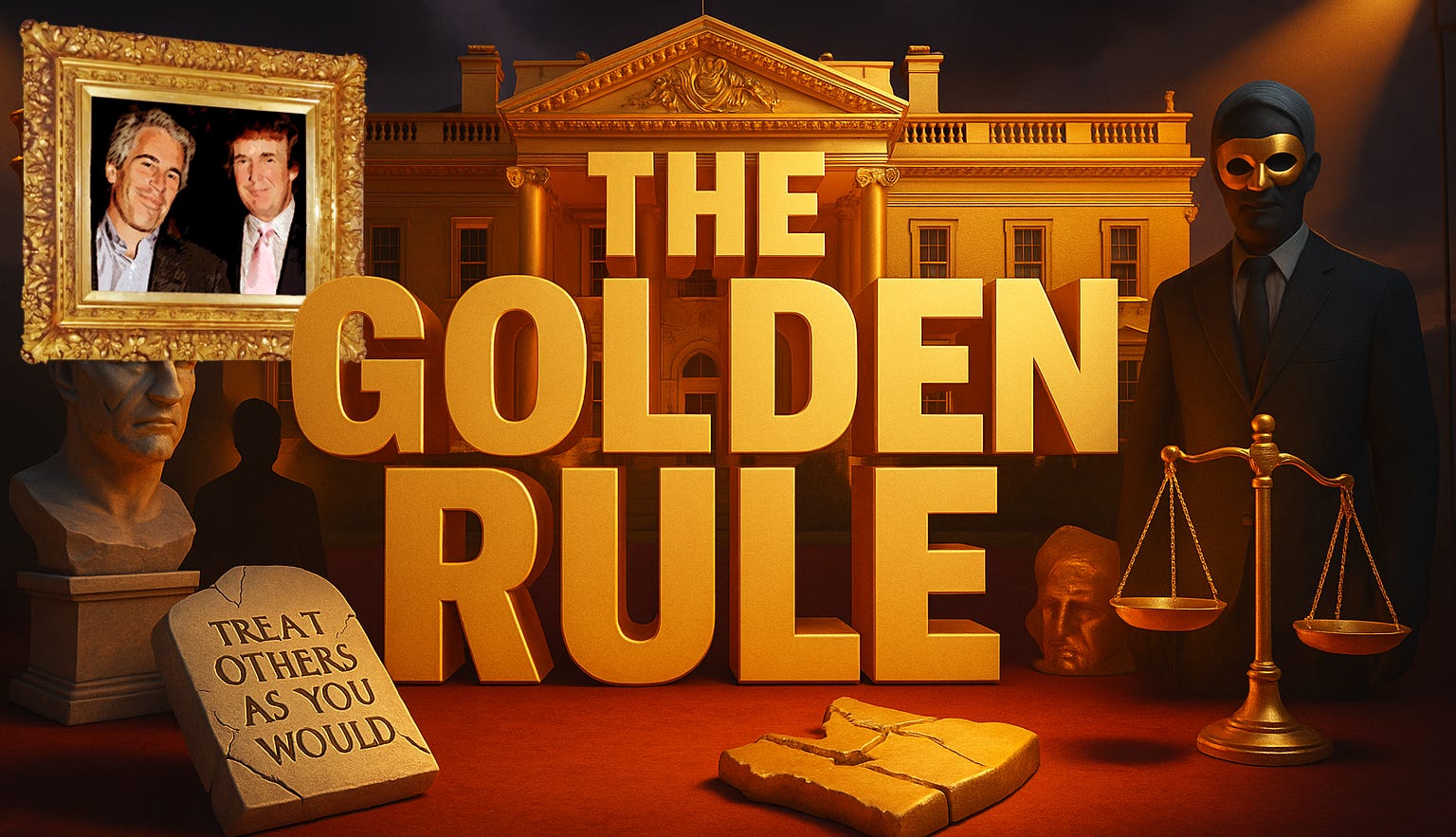
Of all the laws humanity has stitched together over the centuries, none is simpler than this one:
Treat others the way you want to be treated.”
The Golden Rule.
Every culture has its version. Every religion teaches it. Every healthy democracy depends on it.
Which is why it is so jarring to see how far our politics have drifted from it.
Even the visual cues feel symbolic. The White House, historically a symbol of civic humility, now looks like someone merged Versailles with a Home Depot lighting aisle. Gold leaf. Gold trim. Gold upholstery. A palace aesthetic in a place designed for public service, not personal spectacle. That is NOT the Golden Rule.
Thomas Jefferson and John Adams would agree on this at least: the presidency was never meant to be a showpiece of personal grandeur.
But decor is just the surface. The deeper erosion is behavioral.
The Golden Rule is supposed to be our shared civic baseline. The idea that leaders serve everyone, not just the people who flatter them. The idea that public office requires restraint, responsibility, and moral consistency.
Yet in recent years we have seen moments where that principle has felt abandoned.
Government shutdowns where essential benefits like SNAP were nearly withheld. Policies that appear to target and detain people based on status or appearance rather than due process. A political environment where cruelty, mockery, and retaliation are sometimes treated as acceptable governing tools rather than red flags.
And now the Epstein files... whatever one makes of the interpretations and controversies. They have resurfaced painful questions about accountability, proximity to wrongdoing, and the standards we expect from leaders. But these documents raise legitimate concerns for many Americans, not because of partisan identity, but because any alleged ties to exploitation demand scrutiny.
The real question is not “who benefits politically.” It’s “How did we become numb to this?”
Somewhere along the way, we stopped treating decency as a prerequisite for power. We stopped demanding Golden Rule behavior from the people with the most influence over our lives. We stopped expecting empathy, humility, honesty, or even basic moral instinct from our elected officials.
And that is what makes this political moment so dangerous. Not the scandals themselves, but our growing tolerance for them. Because once the Golden Rule disappears from public life, so does the idea of a shared public good.
The fix is not complicated. But it is uncomfortable.
We have to raise the standard again.
We have to expect more from leaders.
We have to reward empathy, not cruelty.
And we have to remember that government only works when the people inside it still believe in mutual obligation.
The Golden Rule is not sentimental. It’s structural.
And if we want a healthier social future, we can’t afford to forget it again..
*AI Disclosure: 95% of this was written by me, a human with only light edits and typo corrections from Grammarly.
PPPPopular Posts:
Mamdani wins by meeting young males online – NYTimes
Face-to-face requests are 34x more effective than emails, study finds – HBR
Democrats’ election wins show embracing trans rights isn’t liability – MSNBC
The end of entry level employees - New York Times
For PPPParents:
Most teens describe news media as biased, boring, or fake – Nieman Lab
2/3 of college students prefer socialism over capitalism – Axios
Parents are literally moving to college with their kids – The Atlantic
Helicopter-parenting flies out of control – The Cut
For PPPProphets:
‘Learn Your Way’ rewrites textbooks, boosts performance – Google Labs
Gen Alpha’s daily digital habits are evolving – Morning Consult
Return of Vine - CNet
Cursor raised $2.3Bn at $29.3Bn valuation; Bubble still in tact - CNBC
For PPPProfits:
Shay Mitchell launches Rini, a skincare line for kids – The Cut
AI startup Gamma hits $2.1B valuation with $100M ARR – TechCrunch,
Nvidia becomes world’s first $5 trillion company – Wall Street Journal
Amazon shares jump 12% as AWS sees 20% AI-driven jump – Reuters