
PPPPress Pause on "Transformation" - Four Ps #272
Because Not Everything That Changes Counts as Real Progress

I’ve always hated the word “transformation.”
It’s the absolute worst of all meaningless, corporate buzzwords. Even worse than “synergy.” Yet somehow, it still finds its way into every deck, speech, and self-help post out there.
For companies, “accelerating transformation” basically admits you’ve already fallen behind. It’s a terrible mindset, this idea that you can just flip a switch, rebrand yourself, and suddenly stay competitive.
And personally? Very few people are capable of true transformation, whether intellectually, emotionally, mentally, or physically.
And then there’s this remember: Trump promised to “transformed America,” but all he did was transmutate us into a land of divisive hatred and lost values. And the White House into a dumpster 𝗳̶𝗶̶𝗿̶𝗲̶ pile.
So maybe it’s time to press pause on transformation... or better yet, delete it from our vocabulary.
That doesn’t mean we shouldn’t evolve or improve. But maybe it’s time to find better, truer words for what that really means.
The Political: Illusions of Progress and Cost of Chaos

It’s Election Day in the United States, and while it’s an off-year for federal offices (still three more years left of Trump, at least), there are still some compelling races to watch.
The New Jersey Governor’s race looks tight. The Town Supervisor race here in my corner of Long Island… maybe less so, though I’m still holding out hope for a miracle.
But the nation’s attention has been fixed squarely on New York City, where the mayoral race between former Governor Andrew Cuomo and State Assemblyman Zohran Mamdani has turned into a national storyline.
Cuomo, once an effective executive before resigning over misconduct allegations, is now trailing by double digits in most polls. Mamdani, just 34, has the support of AOC, Bernie Sanders, and much of the progressive left.
Under other circumstances, I might have been rooting for him, too. His values line up with many of the liberal beliefs I’ve held for years. But this moment is different. And not in a transformational way.
More than anything, we need stability right now.
We’re living through a time when violence against immigrants is on the rise, when antisemitism is raging, and when Jewish communities around the world feel more insecure than at any point in the past 75 years. Mamdani has aligned himself with anti-Israel organizations and has refused to denounce Hamas. That’s a nonstarter for me, and for most Jewish New Yorkers I know, regardless of how progressive they are.
I may not live in the five boroughs anymore, but I’m a New Yorker through and through. I spent 15 years in Manhattan, and I still commute in every day. So even though I can’t vote in this election, it’s still deeply personal for me.
Because if (or when) Mamdani wins, Trump will seize on that victory to attack this city. It’ll become another political punching bag in his culture war.
NYC has the largest Jewish population in the world outside of Israel, somewhere between 1-1.6 million people. Brooklyn alone is home to hundreds of thousands. These are not just statistics; these are neighbors, teachers, families, shop owners, and students. They deserve a leader who makes them feel safe, not sidelined.
Mamdani is young, articulate, and media savvy. Some compare him to Barack Obama. But being a gifted communicator doesn’t automatically make you a capable leader. Obama had depth, empathy, and experience that matured over time. Mamdani, so far, just has the microphone.
His ideas — free subways, free buses, and sweeping reforms — sound bold, but they don’t yet feel grounded in reality.
They feel like the kind of “transformational” promises we keep getting sold in politics.
In this case, let’s pause on this kind of transformation. Not every loud, fast, or shiny idea is progress. Especially the antisemitic kind.
Because if Mamdani wins, far too many will be even more fearful for our future tomorrow than we are today.
The Practical: Finding Your Voice
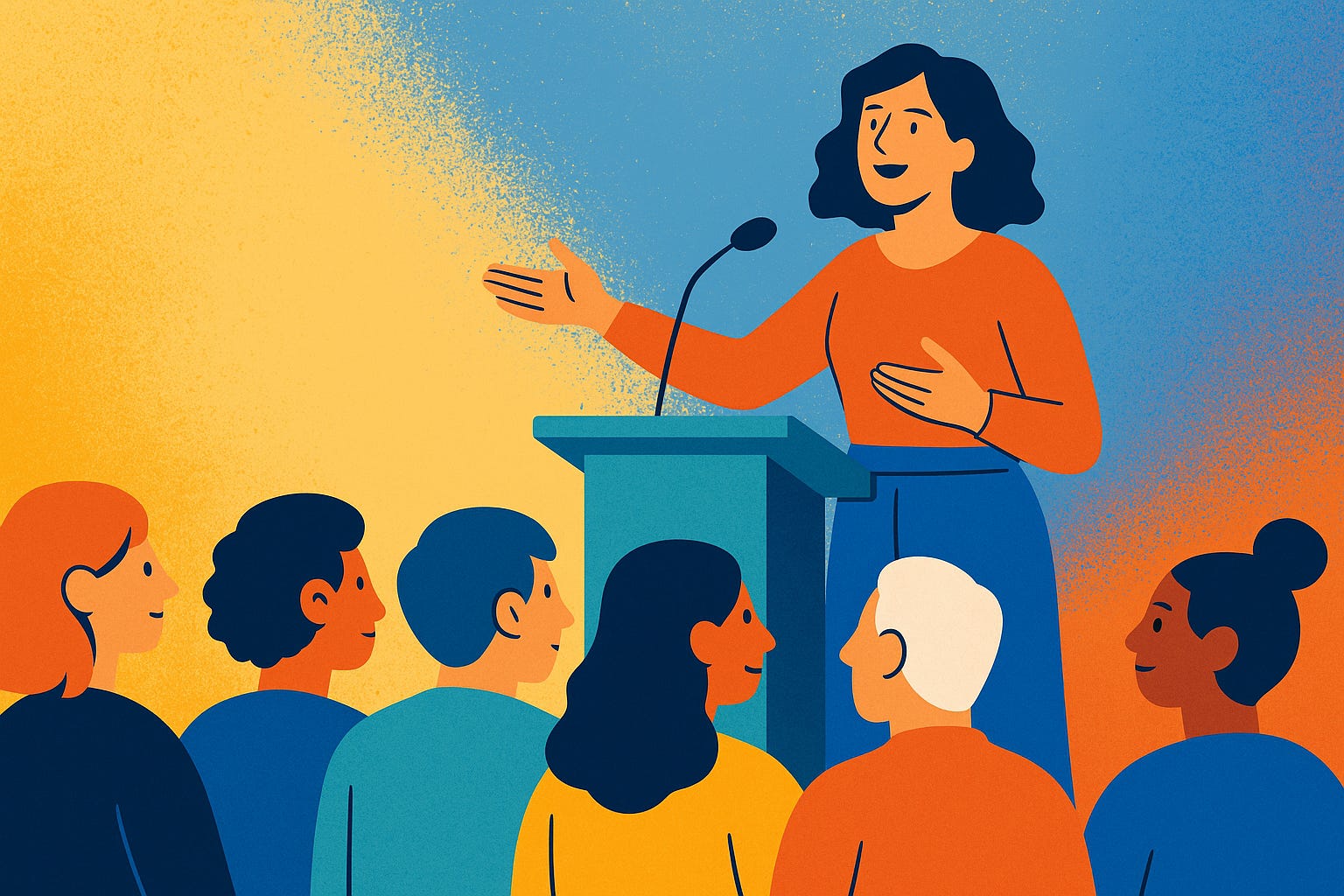
As much as I live for the spotlight, that center-stage attention, speaking more comfortably to a large crowd than just one or two other people, I know not everyone can be a great public speaker.
That said, most people can become good enough. And it does not require any transformation whatsoever.
I say that from experience. Big rooms, small rooms, live events, Zoom boxes. It never really gets easy, but it gets easier.
Skill Building, Not Transformation
That’s the thing about skill building. You don’t wake up one morning with newfound confidence, a sharper voice, and perfect pacing. It is a craft, not a miracle. A slow accumulation of lessons, habits, and self-awareness.
What makes someone good at speaking, or writing, or leading, or listening, is not a reinvention of self. It is the refining of what is already there.
Know yourself and what you stand for. That’s true on a stage, but also in life. Until you have figured out what you actually believe, it is hard to connect with anyone else.
People respond to conviction, not performance.
The best speakers I have seen are not necessarily the most polished. They are the ones who mean it. They have done the work to understand their story:What shaped them
What drives them
What they’ve learned.
Connection over Performance: That’s why finding your voice is not about tone or diction. It is about clarity. It is about understanding your perspective so that when you speak, you are not pretending to be someone else. You are sharing something real.
Then comes connection. The fastest way to lose an audience is to make it about yourself. The fastest way to win one over is to make it about them. That means:Listening
Reading the room
Using stories that reflect shared values.
Whether you’rre pitching, presenting, or giving a toast, the goal is the same: to build a bridge between what you feel and what others might feel too.
You don’t need fireworks or viral soundbites. You need honesty. Humor helps, but sincerity hits harder.Shrink the Room: The best advice I ever got before a speech was to picture one person who really needs to hear what I am saying.
Talk to them. Not the crowd. Not the client. Just one person.It makes everything smaller, calmer, more human.
Practice matters. Rehearsal is not glamorous, but it is the quiet difference between panic and presence. Editing your words, trimming the fluff, knowing your beats: that is where confidence is built.
It is also where you learn humility. You realize how much can go wrong, how easily you can stumble, and how little that really matters.
Because people don’t remember every word. They remember how you made them feel.
Translation, Not Transformation
That’s the secret. Public speaking, like most worthwhile skills, is not about transformation. It is about translation. Translating your thoughts, your beliefs, and your emotions into something others can understand.
It is not magic. It is work. The kind that takes time, attention, and repetition.
So before you try to transform yourself into something new, try refining what is already there. That is where the real progress lives.
The Personal: Pass Me a Pencil
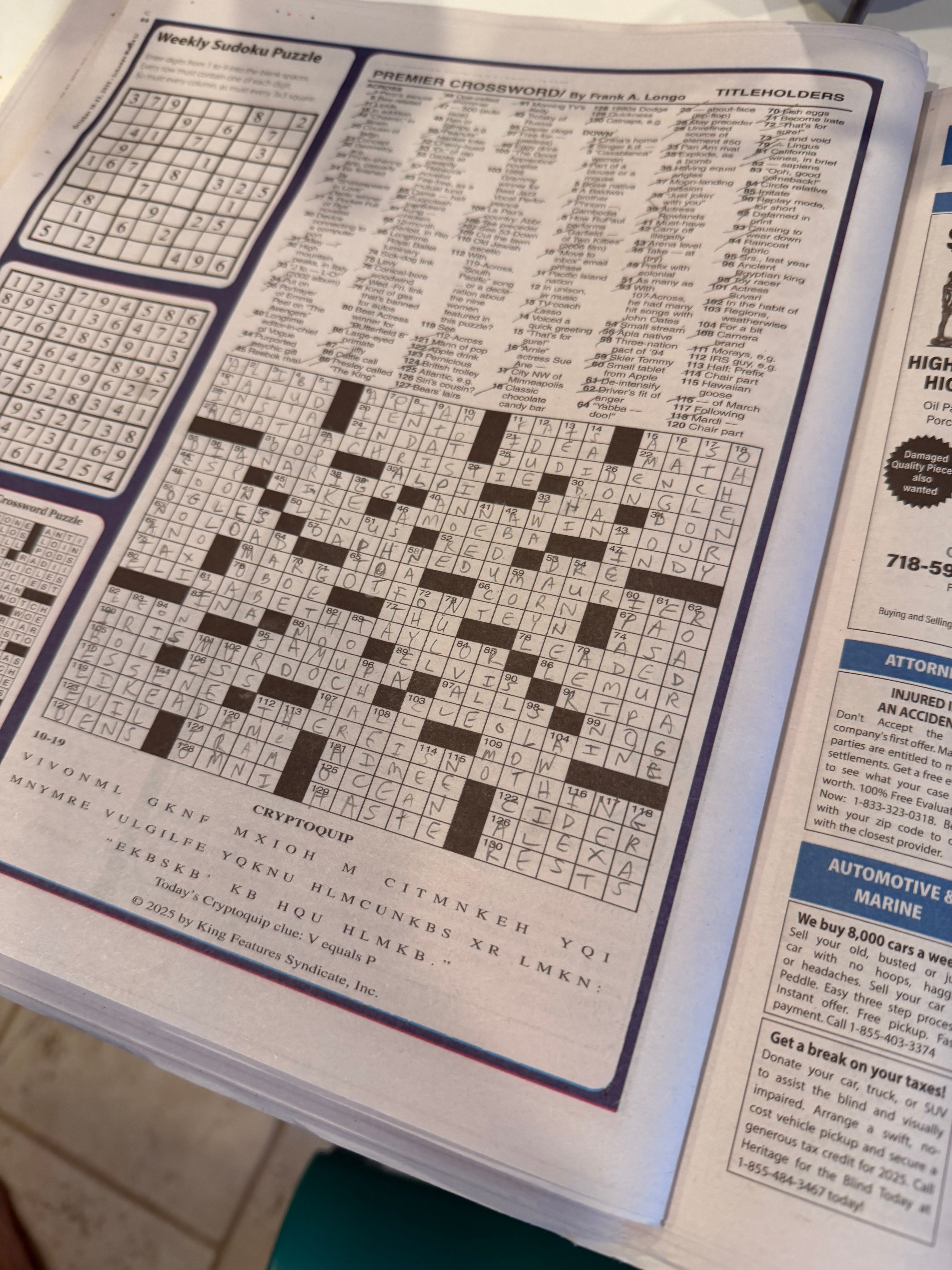
One of my new favorite pastimes of the week (and the clearest proof yet that I’m getting old) is doing the crossword puzzle in our local newspaper.
It’s not easy. It’s a Wednesday New York Times reprint, which means it’s right in that sweet spot between “doable” and “rage-quit.”
But I love it. I even look forward to it, waiting for the mailman to deliver the Port Washington News every Friday afternoon.
Because, well, not all transformations are good ones.
Especially the physical kind that happen as you age. So this is me hitting pause.
This is my resistance... my weekly fight against mental decay. My tiny little act of preservation.
Doing a crossword is my version of yoga for the brain. Stretching the synapses, breathing through the frustration, accepting that sometimes you just won’t remember the capital of Estonia. (It’s Tallinn, by the way. You’re welcome.)
In many ways, this is a full-circle experience, too. I used to do the crossword every day back in college, when the Times puzzle was syndicated in our campus paper on a daily basis. It made me feel worldly, clever, and slightly superior to my hungover roommates.
Then life happened. Work. Kids. Streaming platforms.
Somewhere along the line, my brain traded wordplay for PowerPoints.
But last year, I picked it back up again. Just once a week, on Sunday mornings, coffee in hand, pen in reach (okay FINE... pencil) and that familiar little jolt of joy when 17-Across finally clicks.
It’s not transformation. It’s maintenance. A way to keep the mental gears from rusting while the physical ones start creaking.
So yeah, this is what I have to look forward to in the second half of life, friends.
Not six-pack abs or spiritual enlightenment. Just the quiet satisfaction of remembering an obscure five-letter river in Spain.
Progress, not perfection. Or in this case, not dementia.
The Professional - No, AI Can’t Fix Everything (Yet)

Here’s the thing about “transformation.” It always sounds great in a headline. Until you look at the numbers.
Case in point: ChatGPT referrals. Everyone’s favorite AI assistant is supposedly revolutionizing how people search, shop, and discover. Except… it’s not.
A recent study looked at 973 e-commerce sites generating a combined $20 billion in revenue over 12 months. Guess how much of that traffic came from ChatGPT referrals? A whopping 0.2 percent. That’s 200xsmaller than Google organic search.
Even worse, ChatGPT traffic converts worse than almost every other channel. Paid and organic search still dominate on conversion and revenue per session. Affiliates and email do better. The only thing ChatGPT beat? Paid social. (Low bar, I know.)
Sure, the bounce rates were decent, and the traffic is growing. But it’s still window shoppers, not buyers. Awareness, not action. Interest, not intent.
This is why agentic commerce within LLMs is getting so much attention. Because we’re staying in ChatGPT all day...
And that’s the larger story with all this “AI transformation” talk. It’s not that AI doesn’t work... it’s that it hasn’t yet transformed much of anything (yet) outside of headlines and layoffs.
The Economy, Stupid
Goldman Sachs just dropped a report calling this moment a new era of “jobless growth.” GDP is climbing, corporate earnings are strong, but hiring has flatlined. New hires are down 58 percent year-to-date... the lowest since 2009.
Goldman economists say this is partly because of AI. Not because it’s creating efficiency, but because it’s creating cover. A nice, shiny narrative that lets companies “streamline” (read: cut jobs) while telling investors it’s all about innovation.
Jerome Powell calls the labor market “low-hire, low-fire.” Translation: nobody’s getting hired, and the people getting fired are victims of cost-cutting more than anything else.
Failing Fast
Meanwhile, MIT researchers found that 95% of companies fail at AI deployments altogether. They invest millions, fall short of ROI expectations, then quietly rehire or outsource the same work to humans again. It’s not transformation. It’s treadmill management with a new buzzword.
And yet, the myth persists. Every boardroom wants an AI strategy, even if it means copying and pasting something that sounds futuristic into a slide deck. Because nothing says progress like pretending the robots are coming while the humans are still debugging spreadsheets.
So let’s press pause on the “transformational” hype, well, everywhere.
Yes, AI will eventually reshape industries, but not overnight, and not by magic. The winners won’t be the ones who chase headlines. They’ll be the ones who adapt thoughtfully, layer by layer, learning how to integrate new tools into existing systems.
For now, Google still drives the buyers. Humans still drive the economy. Genuin is building AI for brands to use within their O&O.
And transformation, at least for the moment, is still a story we’re telling ourselves to feel better about not having all the answers.
*AI Disclosure: 95% of this was written by me, a human with only light edits and typo corrections from Grammarly. 3 of the 4 images are AI-generated. The crossword image is real!
PPPPopular Posts:
OpenAI’s Sora can now fool human deepfake detectors with realism – FastCo
Creative Effectiveness Gap: Why ads fail to drive impact – The Media Stack
Meta’s new AI ‘Vibes’ feed boosts app downloads and Gen Z use – Tubefilter
Deloitte: U.S. consumers plan to spend 10% less this holiday season – Retail Brew
Atlas may distort ad metrics by mimicking human clicks – Search Engine Land
For PPPParents:
Marketers embrace anti-AI messaging to win over Gen Z – Business Insider
Gen Z pushes back on parents posting family photos online – The Cut
Why ‘screen time’ no longer means anything in a digital life – The Atlantic
For PPPProphets:
Revise: AI writing tool that polishes text while preserving your tone” – Revise
Eli Lilly and Nvidia build supercomputer to accelerate drug discovery – CNBC
OpenEvidence, the ‘ChatGPT for doctors,’ hits $6B valuation – New York Times
Ad industry debates new ‘agentic AI’ standard amid growing buzz – The Current
Snap reportedly raising $1B to fuel next wave of AR glasses – Sources News
For PPPProfits:
OpenAI restructures into for-profit arm valued at $500B – Bloomberg
Mondelez to launch AI-generated TV ads, cutting costs in half – The Verge
Talent acquisition startup Findem raises $36 million Series C - Crunchbase
AI-generated de-aged Harrison Ford stuns viewers with lifelike realism – Seedream
Perplexity signs multi-year Getty Images deal for licensed visuals – TechCrunch
For PPPProfits:
Reddit CEO says AI chatbots don’t drive meaningful site traffic – TechCrunch
Meta’s $160B stock drop follows announcement of AI plans – Financial Times
AI agents still struggle with real-world freelance work benchmarks – Wired
Grammarly rebrands to Superhuman as it doubles down on AI – The Verge