

I’ve been rethinking a lot lately. Not just ideas or opinions, but also formats.
Habits. Assumptions. Including this one.
Because most of the content that gets the most attention right now makes me want to throw my phone into Manhasset Bay. Not because it’s wrong. Because it’s loud. Simplistic. Designed to make you mad instead of make you think.
And it works.
The Four Ps has always been my space to slow things down. Long-form writing is still my passion. It forces clarity. It forces honesty. It forces me to finish a thought instead of firing off a take built for engagement instead of truth.
But media has changed. Audience behavior has changed. Attention has fractured.
Short-form video dominates social. Snacking beats meals. Even good ideas get skimmed, half-read, or ignored entirely. Writing something like this, start to finish, is a real time commitment when it’s all coming straight from my brain and keyboard.
So I’m asking myself a real question heading into a new year: Not just what should I say, but how should I say it in a world that rewards outrage over nuance.
This is the penultimate Four Ps of 2025. And honestly, good riddance to this year.
Oxford just crowned “rage bait” as Word of the Year. Content engineered to provoke outrage for clicks, engagement, and dopamine. And instead of rolling my eyes, I started wondering something more uncomfortable.
Are we raging about the right things? Are we applying chainsaws where scalpels are needed? Or scalpels where decisive action is long overdue?
So let’s get to these Ps with that question in mind. Not to manufacture outrage, but to focus it.
PERSONAL: “Oh, What Fun It Is...”

I took my daughter to her first concert this week. Although calling it a “concert” feels generous. It was Jingle Ball at Madison Square Garden. Five hours. A dozen artists. A few songs each. The most chaotic tasting menu of pop music imaginable.
But honestly, it wasn’t about the lineup. It was about watching her watch the world. The lights. The noise. The real people. New York City. MSG! That energy you cannot pause or scroll past. I’m not sure that Oxford’s erudite scholars have a word that defiines this feeling, but the power of live experiences that hit your senses in a way digital never will.
It also reminded me of something uncomfortable.
I have to do better as a parent. I have to force myself to create and connect my kids with real-world experiences. And myself too. It is way too easy to let school, sports, work, and screens take over the calendar until suddenly the year is gone and you cannot remember the last thing you did that did not involve a login.
Because the truth is the digital world is creeping into childhood faster than any of us expected. Not just social media anymore. AI is now fully rewiring the way kids learn, play, and build relationships.
The Economist reported that robot tutors and adaptive AI toys are creating ultra-personalized childhoods, where homework becomes a cartoon strip and video games let kids talk to Darth Vader as if he were a classmate.
Some teens now say AI companions feel as satisfying as talking to a friend, which might sound charming until you realize they are talking to a yes-bot that never disagrees. No conflict. No friction. No social muscle development at all.
Layer this on top of the other challenges: A new study shows that social media is nuking children’s attention spans. Not screens in general, just the nonstop, dopamine-soaked feeds. ADHD diagnoses have jumped to 7MM kids in the US, up a million in six years. The biggest correlation is social platforms designed to keep them hooked.
I wrote about this last week in The Great Social Media Breakup for the Genuin Blog, and the data keeps coming. Even a one-week detox produces meaningful improvements in anxiety, depression, and sleep. Imagine what a month could do.
Then there are the safety risks:
More teens are using AI chatbots for companionship and emotional support, often late at night, often without parents aware. Several lawsuits claim chatbots played a role in teen suicides. OpenAI and Character.ai have both added guardrails. Some are winding down freeform chats for minors altogether.
But researchers keep finding that these systems fail when the conversation veers into anxiety, depression, mania, eating disorders, or anything that requires real clinical judgment. The tech is evolving faster than the guardrails, and the guardrails are evolving faster than the regulators.
And the device question has never been more important.
A University of Pennsylvania study shows that getting a smartphone at age 12 increases the risk of depression by 31%, obesity by 40%, and poor sleep by 62%.
Yike-a-roonies!
The recommendation is increasingly clear. Delay smartphones. Introduce technology in phases. Give them a watch first. The Atlantic called the smartwatch the “training tool for life online,” a way to let kids feel connected without giving them access to a firehose of social content they are not ready to handle.
So yeah, last weekend at Jingle Ball, watching my daughter scream next to thousands of strangers during the K-Pop Demon Hunters sing-along with other real, breathing humans, I felt this moment land in my chest.
Screens are not the enemy. AI is not the enemy.
The enemy is letting ALL OF IT become the default.
Kids need more live experiences, more friction, more boredom, more conflict resolution, more actual joy, not algorithmic stimulation dressed up as joy. And they need parents who create space for that. I say this mostly to myself.
In 2026, I want to be intentional. More concerts. More mess. More real world. More guardrails for the digital world. More education on responsible AI use.
And more moments where their childhood is shaped by something other than a feed or a model.
Maybe parenting is just choosing what rewires their brains. (And choosing carefully.)
PROFESSIONAL: Pressure Cooking with AI
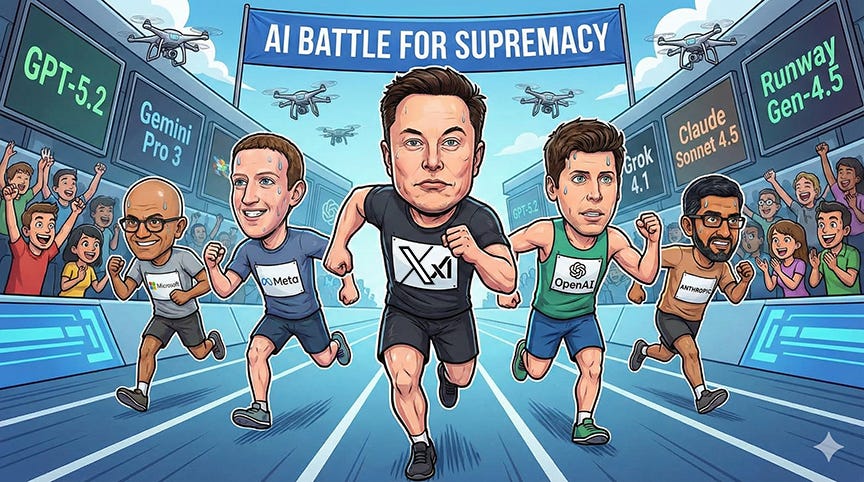
As far as I know, there is no word in the English language that adequately explains what I feel right now. It’s a very strange mix of both excitement and exhaustion at the same time.
Have you ever been so energized, enthusiastic, enthralled, yet fatigued and frazzled all at once? That’s AI for me right now.
But first, an apology: Somehow three, often four of the Four Ps per edition have drifted into AI territory over the past few months. Professionally and personally, it’s been the gravitational pull I can’t escape. I need to do better.
But also… if I don’t write about it, I’ll blink and be six innovations behind before breakfast. The pace this year has been staggering. It’s like standing on a moving walkway that keeps speeding up even when you’re already jogging.
And the specialization is getting wild. Models aren’t just “models” anymore. They’re specialists. Writers. Coders. Artists. Directors. Like the world’s most chaotic liberal arts college.
Pre-training fills their brains with everything under the sun. Post-training gives them their majors.
And suddenly GPT-5.2, Gemini Pro 3, Grok 4.1 Thinking, and Claude Sonnet 4.5 are the writer kids who live in the creative writing house… while Claude Opus 4.5 is the engineering student who actually attends office hours. The race is on.
Then you’ve got the arts program:
- Nano Banana Pro dominating images.
- Runway Gen-4.5 crushing text-to-video.
- Veo 3, Kling 2.5, and Sora 2 Pro elbowing each other for the director’s megaphone.
Choosing the right model now feels less like browsing tools and more like casting a movie. Every role needs the right actor. And the cast list changes daily.
This is where excitement starts tripping over anxiety. Not FOMO, exactly. More like being a hockey goalie in warmups. Pucks flying. No whistle. No mercy. Just vibes.
And then there’s the job thing.
MIT says AI could replace around 11.7% of the labor market, which translates to $1.2 trillion in wages and an entire buffet of jobs across tech, HR, logistics, finance, and admin.
McKinsey says AI and robotics could automate activities representing 57% of US work hours.
Microsoft ranked the 40 jobs most exposed to generative AI, including historians, translators, sales reps, technical writers, and data scientists.
Meanwhile… companies aren’t exactly waiting for the research papers to cool.
HP is cutting 6,000 roles as it leans harder into AI.
Lufthansa cut 4,000. Fiverr dropped 30% of its staff as it transitions into an AI-first company.
Klarna, Salesforce, Accenture... same energy.
And inside all this disruption… Workers feel it. KPMG says 52% now fear displacement. (Up 2x from last year.)
Automation is inevitable, but intelligent human reinvention needs to be just as inevitable.
The “sweet spot” is simple to say and hard to execute: let agents handle the tedious tasks people hate, while humans move into the roles where intuition, creativity, context, and nuance still matter... and will still matter more.
But here’s where the hope wins over the hype.
I’ve been at the table with brilliant and talented colleagues building something real at Genuin, a foundational, practical, AI-led solution with features that aren’t theoretical, aren’t sci-fi, and aren’t “coming someday.” They’re coming now. You’ve seen glimpses, but what’s next is genuinely game-changing.
The only way to defend and protect yourself in all this chaos is ownership, embedding a wrapper of agents inside your own channels that:
orchestrates third-party, first-party, and partner agents
keeps your data and context on your terrain
builds value and intelligence you actually get to keep
Hope over hype. Control over chaos. Ownership over everything.
PRACTICAL: Pruning With a Chainsaw

I haven’t written about the New York Mets all year. At least not here.
And while it took a pretty dramatic dismantling of the roster to finally pull me back in, it’s also too early to comment on where this team is going until it’s actually rebuilt.
But there is a practical lesson in what just happened over the past two weeks.
Sometimes you don’t need a scalpel, but a chainsaw.
After massively underperforming in 2025, collapsing down the stretch, and missing the playoffs despite a mega payroll, the verdict was clear. Offense showed up. Individual stars had great years. Pitching and defense did not. And now the whispers of clubhouse issues are getting louder.
Then came the moves.
Brandon Nimmo, a fan favorite and steady presence, gets traded for an aging but talented infielder. Pete Alonso walks in free agency without an offer. Edwin Diaz signs elsewhere after the Mets make it very clear they’re not matching or exceeding the Dodgers.
Was I sad? Sure. Disappointed? Maybe. Angry? Not really.
Because their press conferences told the real story.
Diaz was played hardball. No flexibility. No signal he was truly wanted. Billionaire Steve Cohen’s track record says if he wants you, money isn’t the obstacle. Signing another closer, albeit far inferior, in Devin Williams without a heads-up sent the message that Sugar was expendable. He heard it.
Pete’s situation was even clearer. Dating back to last season, GM. David Stearns had no appetite for a first baseman unless it was on a bargain deal. I believe Pete would have stayed for less than Baltimore offered. That was still too rich for the Mets. Fan sentiment didn’t matter.
But here’s the practical takeaway: This wasn’t about underperformers on bloated contracts. These guys had strong seasons. They were good clubhouse ambassadors. But leadership decided the reset had to be decisive, not delicate.
It was about value, not about cost.
And here’s the risk: Every employee, no matter how well compensated, wants to feel valued. In all three cases, the Mets made it clear they were only interested on terms that favored the organization entirely. That may be how modern business works. But players and employees notice. Agents notice. Other stars notice.
When money is equal, culture and intent become the differentiators.
Chainsaws can clear space fast.
But what you build next matters just as much.
POLITICAL: Protect People, Not Power
It’s been two days since two more horrific shootings grabbed the headlines. One on the campus of Brown University. Another during a Hanukkah celebration in Australia. And I genuinely don’t have anything new to say about it anymore.
Which might be the most damning part.
We failed as a civilization the moment mass shootings became background noise. Sandy Hook was the line. Its anniversary coinciding with this latest wave feels cruel, but also disturbingly predictable. This is abhorrent. It’s tragic. And now, it’s totally normal.
There are nuances. There are laws already on the books. There are constitutional debates and edge cases and policy tradeoffs. Fine. But the fact that we cannot collectively take a single meaningful step in this country to reduce hundreds of mass shootings and tens of thousands of gun-related deaths and injuries every year fits the literal definition of insanity. Same inputs. Same outcomes. Same funerals.
Instead, we keep electing leaders who obsess over culture war nonsense while doing absolutely nothing about the one thing that keeps killing children in classrooms, people in places of worship, and strangers at grocery stores.
What are we even doing here?
This is where the metaphor flips from the last section.
Sometimes an organization needs a chainsaw.
A government does not.
Right now, we are lighting entire forests on fire to prune a few limbs. We are dismantling norms, threatening civil liberties, and manufacturing fear, all while refusing to apply even the most basic, evidence-backed measures that could save lives. Universal background checks. Red flag laws. Safe storage requirements. Not radical ideas. Not new ideas. Just ideas that work everywhere else.
At the same time, the current administration seems far more interested in policing speech than protecting people.
Trump’s National Security Presidential Memorandum 7 lays the groundwork to investigate and potentially prosecute individuals and groups by equating dissent with “domestic terrorism.” Not violence. Not action. Speech. Ideas. Criticism.
A majority of voters believe Trump will attempt to restrict speech critical of him and his administration. This includes calling his movement fascist at 59%, supporting DEI at 55%, supporting nontraditional views on gender and sexuality at 53%, criticizing the government at 52%, and supporting socialism at 52%. Yet far fewer voters actually want any of this speech restricted. 60% say they’re concerned about NSPM-7, including large majorities of Independents and marginalized communities.
This is not strength. It is insecurity weaponized.
We live in a country where leaders claim they cannot figure out how to stop gun violence, but somehow have endless energy to silence critics. Where classrooms are treated as acceptable risk, but dissent is framed as a national threat.
We do not need more fire. We need focus. We need precision.
And above all, we need the political will to treat mass gun violence as the emergency it is.
Because a society that cannot protect its people, but can punish its critics, has already lost the plot. Be safe, and let’s take care of each other…
*AI Disclosure: 95% of this was written by me, a human with only light edits and typo corrections from Grammarly.
PPPPopular Posts:
Student-run newsrooms fill gaps left by disappearing locals – Columbia Journalism Review
India’s push for AI independence amid talent, language challenges – MIT Tech Review
Social media isn’t built for vigilance against GenAI video deception – N.Y. Times
For PPPParents:
Gen Alpha now wants in-game currency more than toys or cash – Fast Company
AI becomes fast-growing college major nationwide – New York Times
Navigating the increasingly complex ecosystem of Allowances - The Atlantic
Teen social media usage: ‘almost constant’ usage, AI adoption rise – New York Times
For PPPProphets:
AI becomes one of the fastest-growing college majors nationwide – NY Times
New AI tool aims to eliminate the CFO’s decision bottleneck – CFO-X
FAST viewing surges 43% as ad-supported streaming accelerates – The Current
Google’s Sundar Pichai says workers must adapt as AI disrupts jobs – Yahoo
For PPPProfits:
SpaceX targets late-2026 IPO at a potential $800B valuation – Quartz
Nothing opens $5M community investmentat $1.3B valuation – TechCrunch
Instacart’s AI raises prices up to 20% based on shopper sensitivity – CNN
How TikTok turned influence into frictionless, inescapable shopping – The Verge